VTM Liners
Screw, tank and grid liners for vertical stirred mills — tower mills, VTMs and Vertimill-type machines — cast in high-chromium alloy matched to fine-grinding duty, to your drawing.
Why VTM liners are a different product
A tower mill is not a ball mill stood on end. The shell does not rotate — a central screw stirs small media in a tall, quiet column, and the mill grinds by rolling and compression instead of impact. That changes the liner problem completely: wear moves from impact denting to fine abrasion under a dense media bed, and the money moves with it. On tower mills we have tracked from published concentrator data, screw liners — not shell liners — carry most of the liner budget, because the lower screw runs in the heaviest, most abrasive part of the media bed.
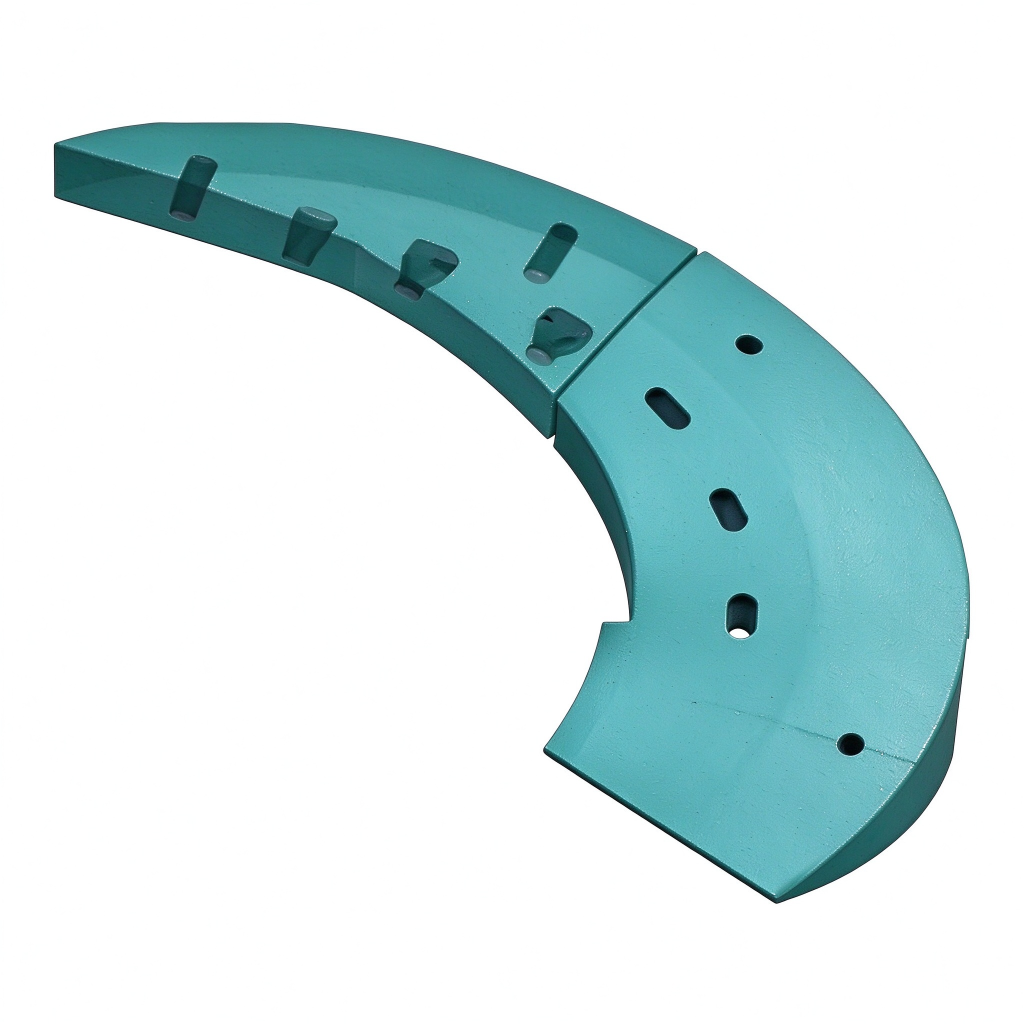
The wear you are buying against
Published data from an iron-ore concentrator running tower mills in tertiary grinding tells the story. In a side-by-side comparison against the ball mills they replaced, the tower mills ground 1.7× more efficiently per unit volume, drew 30% less power and cut media consumption 43% — but the liner spend went up, because screw liners wear faster than the magnetic shell liners the ball mills ran.
That is the trade you are making when you buy VTM liners: energy and media savings against a liner line-item that needs to be as cheap per tonne as you can make it. Material choice is where that is decided — and in fine grinding, the data keeps pointing at high-chromium alloy.
Where the wear actually comes from
Four wear mechanisms share the work inside a vertical stirred mill, and each hits a different component. The lower screw gets the worst of all of them — it runs buried in the densest part of the media bed, which is why published field data shows it relining roughly 2.5× more often than the upper screw on the same machine.
| Component | Dominant wear mechanism | What the field data shows |
|---|---|---|
| Lower screw liners | High-stress abrasion under a dense media bed, plus coarse feed entering the bed | Shortest life on the mill — relined every ~3–4 months in published iron-ore service |
| Upper screw liners | Media rolling and slurry scour at lower media pressure | ~2.5× the life of lower screw liners in the same installation |
| Tank / grid liners | Fine-particle slurry erosion; grid cells pack with media and self-protect | Very long service — grid cells form a protected layer of media and ore |
| Base and discharge liners | Slurry jetting at the discharge, media weight at the bottom plate | Moderate; driven by slurry velocity more than media load |
Why high-chromium alloy for VTM duty
Fine grinding is the one place in a concentrator where high-chromium white iron is almost always the right answer — and it is worth being straight about why manganese is wrong here. Hadfield steel earns its keep by work-hardening under impact. In a stirred mill there is almost no impact: small media roll and press against the liner, and the surface of a manganese screw liner never sees enough impact energy to harden. It wears soft, and it wears fast.
| Grade | Typical hardness | Best-fit VTM position |
|---|---|---|
| Cr15 high-chrome | HRC 58–62 | Screw liners under moderate media load |
| Cr20 high-chrome | HRC 60–64 | Lower screw, heavy media bed, hard ores |
| Cr26 high-chrome | HRC 60–65 | Corrosive slurries (acidic / chloride) plus abrasion |
| Cr-Mo alloy steel | HRC 45–52 | Positions with tramp-metal or oversize feed risk |
The microstructure is a hard martensitic matrix carrying M7C3 carbides at roughly twice the hardness of quartz — the mineral doing most of the cutting. Against a rolling, low-impact media bed, that carbide network is exactly the right tool.
High-chromium iron trades toughness for hardness. If your circuit lets tramp metal or oversize feed into the mill, say so when you send the drawing — we would rather cast a tougher Cr-Mo position than have you break a screw liner in service.
The complete VTM liner package
We cast the full liner set for vertical stirred mills, not just the screw. Positions are quoted individually or as a package — per your drawing, per position, so you can run different grades where the duty differs.
What we cast
- Screw flight liners — upper and lower, hard-facing on the wearing edge optional
- Screw hub and shaft wear sleeves
- Tank wall grid liners — cast to your grid pitch
- Base plate and discharge box liners
- Counter-weight and deflector liners where fitted
Machine types covered
Drawings arrive for many names of the same machine — VTMs, tower mills, Vertimill-type stirred mills, vertical spiral stirred mills. We cast to the drawing, so the OEM label matters less than the part number on your sheet: send what you have and we will match it.
Typical manufacturing envelope
- Tank diameter1.0 – 5.0 m
- Screw liner single weight15 – 800 kg
- MaterialsCr15 / Cr20 / Cr26, Cr-Mo
- Hardness (high-chrome)HRC 58 min
- Bolt hole tolerance±1.5 mm
- Machined face tolerance±0.5 mm
If a liner falls outside these ranges, send the drawing anyway — we will tell you honestly whether we can cast it and how.
Send your drawing — we do the rest
What we need from you
Send the drawing and we can quote. If any item below is missing we will ask before the pattern is cut — the earlier the question, the cheaper the answer.
- 2D drawing (DWG or PDF) or 3D model (STEP / IGES)
- Mill make, model and screw diameter
- Position on the screw or tank, upper or lower
- Slurry description — pH, chloride if known, feed size
- Current liner life and material, if known
What you get back
- Engineer’s review of the drawing within 24 hours
- Firm quotation — material grade recommended for each position
- Chemical analysis and hardness certificate with every pour
- Dimensional inspection report before shipment
Common questions
Will high-chrome screw liners crack in my mill?
Not from normal fine-grinding duty — the impact energy in a stirred mill is low, and that is precisely the condition high-chrome is built for. Cracking risk comes from tramp metal or oversize feed. Tell us what your circuit actually does and we will match the grade accordingly, including tougher Cr-Mo where the duty warrants it.
Can you match OEM screw liner drawings?
Yes. We cast to the drawing you send, whatever the machine is labelled. If you only have a worn sample and no drawing, send photos and the machine model — we can reverse-engineer from a pattern of your old parts.
My slurry is acidic. Does that change the grade?
It can, significantly. Corrosion and abrasion together multiply wear — acidic or chloride-bearing slurries usually justify stepping up to Cr26, whose carbide volume and chromium content resist the corrosion side of the attack. Give us the pH range when you send the drawing.
Send us your drawing — get a quote within 24 hours
Upload DWG, PDF or STEP files. Our engineers review every drawing and come back with a technical reply and a firm quotation — no obligation.