Manganese or Cr-Mo — decided by duty
Two material families cover almost every mill liner position. The question is never which one is better, but which one belongs in that position on your mill.
Manganese steel — hardness that arrives under impact
Manganese Steel
Austenitic manganese steel — Hadfield steel — is the traditional mill liner material for one reason: it work-hardens. The surface layer hardens under repeated impact while the core stays austenitic and tough, so the liner resists wear without becoming brittle.
The trade-off is real. Manganese starts soft, and in a low-impact abrasive duty it will simply wear away faster than a quenched alloy steel. It earns its place where the charge hits hard.
- Grades suppliedAMS-A0 – A4 · Mn13 – Mn18Cr2 family
- Initial hardness170–230 HB
- Work-hardened surfaceup to 500 HB
- MicrostructureAustenite + carbides
- Heat treatmentWater toughening
- Best applied toFeed ends, coarse chambers, lifter bars
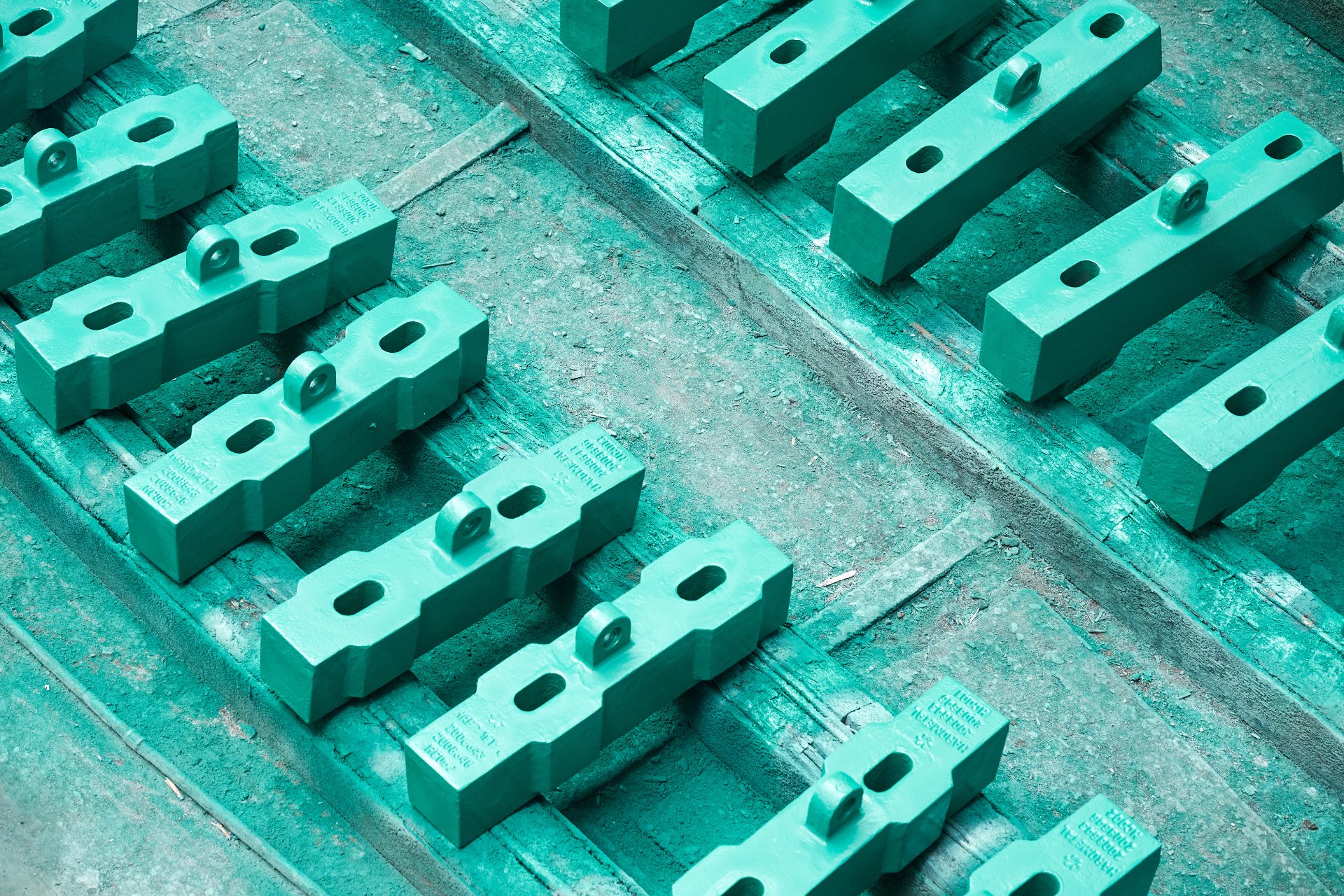
AMS austenitic manganese steel — chemistry and properties
Our AMS series covers five austenitic manganese grades, from the standard Hadfield analysis (AMS-A0) to micro-alloyed and high-manganese variants. Where each grade earns its place:
- Medium and high-speed mills — repeated ball drop and fall drives the work-hardening AMS grades live on.
- Top ball size over 80 mm — heavy impact builds the hardened surface layer that delivers the wear life.
- Acid or alkaline slurries — the alloyed, corrosion-resistant variants (AMS-A1 to A3) are the right call for aggressive circuits.
| Grade | Chemical elements (%) | |||||||
|---|---|---|---|---|---|---|---|---|
| C | Si | Mn | Cr | Mo | V | P/S | Ti | |
| AMS-A0 | 1.1–1.3 | 0.3–0.6 | 12–14 | 0–1.2 | 0–0.5 | / | ≤0.05 | / |
| AMS-A1 | 1.1–1.3 | 0.3–0.6 | 12–14 | 1.5–2.5 | 0–0.5 | / | ≤0.05 | / |
| AMS-A2 | 1.1–1.3 | 0.3–0.6 | 12–14 | 1.5–2.5 | 0–0.5 | 0.15–0.5 | ≤0.05 | 0.05–0.2 |
| AMS-A3 | 1.1–1.3 | 0.3–0.6 | 12–14 | 1.5–2.5 | 0.5–1.5 | / | ≤0.05 | / |
| AMS-A4 | 1.2–1.4 | 0.3–0.6 | 16–18 | 1.5–2.5 | / | / | ≤0.05 | / |
| Grade | Hardness (HB) | Impact AKU (J/cm²) | Elongation | Tensile Rm (MPa) | Microstructure |
|---|---|---|---|---|---|
| AMS-A0 | 170–240 | ≥100 | ≥30 | ≥685 | A + C |
| AMS-A1 | 180–240 | ≥80 | ≥25 | ≥735 | A + C |
| AMS-A2 | 200–240 | ≥60 | ≥10 | ≥785 | A + C |
| AMS-A3 | 180–240 | ≥80 | ≥25 | ≥735 | A + C |
| AMS-A4 | 190–240 | ≥120 | ≥25 | ≥795 | A + C |
A = austenite, C = carbides (water-toughened). AKU = unnotched Charpy impact energy. P/S = phosphorus and sulfur, each ≤0.05%. Values are guaranteed minima/ranges per heat; mill certificates issued with every shipment.
Cr-Mo alloy steel — hardness that arrives from the furnace
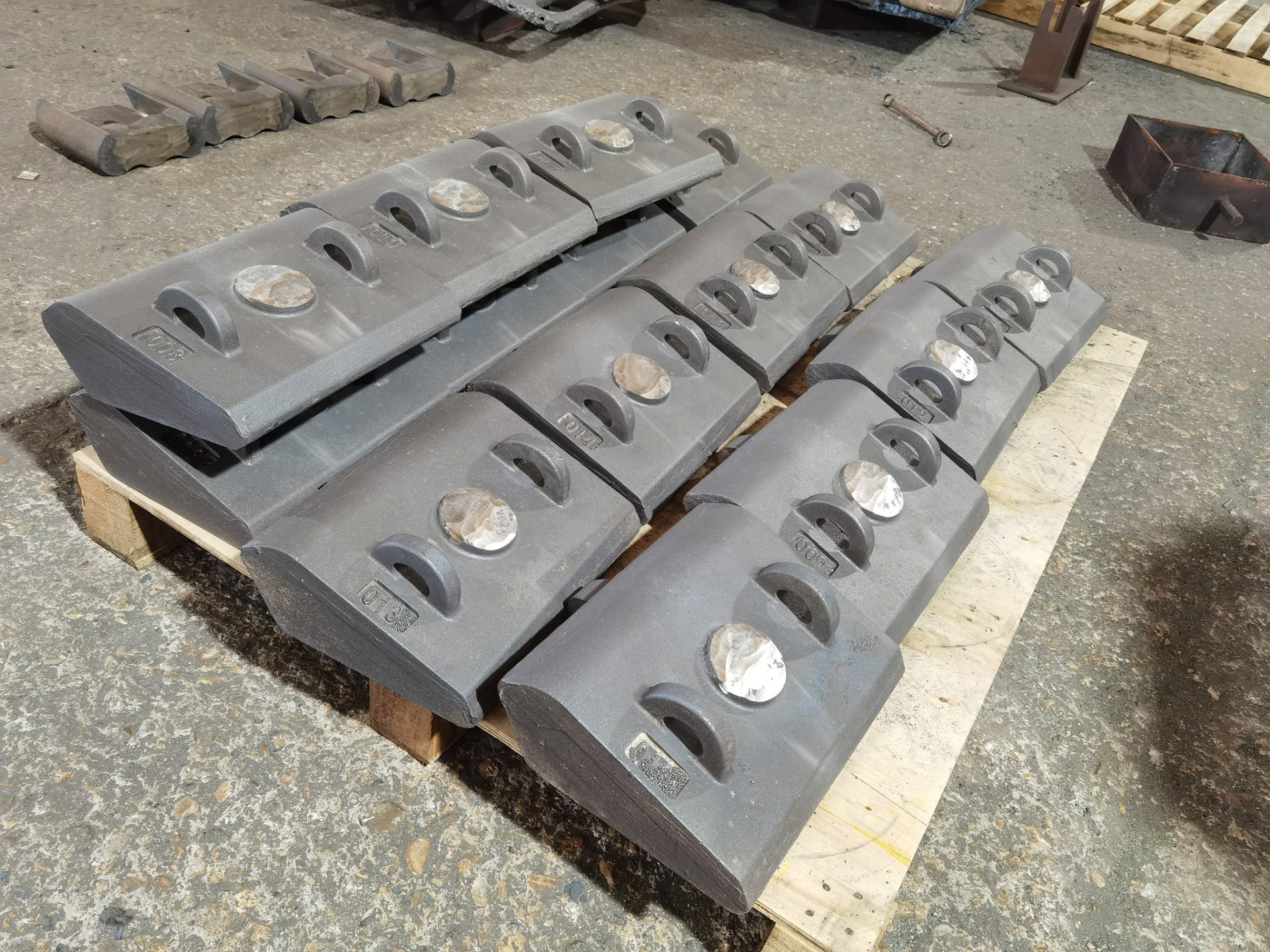
Cr-Mo Alloy Steel
Low-alloy steel, quenched and tempered to a martensitic or bainitic structure. It arrives hard instead of becoming hard, which is exactly what an abrasion-dominated position needs.
Use it where the charge slides rather than strikes: fine grinding chambers, grate plates, pulp lifters and areas where manganese has historically worn thin without cracking.
- Grades suppliedP1 · M1 · M2 (Cr-Mo low alloy)
- Hardness range325–520 HB
- MicrostructurePearlite (P1) · Martensite + carbides (M1/M2)
- Heat treatmentQuench and temper
- ToughnessLower than manganese
- Best applied toFine chambers, grates, pulp lifters
Cr-Mo alloy steel — chemistry and properties
Three Cr-Mo analyses cover the abrasion-dominated duties, from the pearlitic P1 to the fully martensitic M2. Where each grade earns its place:
- Medium and low-speed mills — higher as-cast hardness suits grinding-dominated, abrasion-heavy duties.
- Top ball size 80 mm and under — smaller balls hit lighter, abrasion outweighs impact, and Cr-Mo outlasts AMS here.
- Acid or alkaline slurries — molybdenum and copper additions carry the corrosion resistance.
| Grade | Chemical elements (%) | |||||||
|---|---|---|---|---|---|---|---|---|
| C | Si | Mn | Cr | Mo | Cu | P | S | |
| P1 | 0.60–0.90 | 0.4–0.7 | 0.6–1.0 | 1.8–2.5 | 0.25–0.4 | 0–0.5 | ≤0.04 | ≤0.06 |
| M1 | 0.35–0.45 | 0.4–0.8 | 1.3–1.6 | 2.4–2.7 | 0.6–0.7 | 0–0.5 | ≤0.04 | ≤0.06 |
| M2 | 0.30–0.50 | 0.4–0.8 | 0.8–1.2 | 4–6 | 0.6–1.2 | 0–0.5 | ≤0.04 | ≤0.06 |
| Grade | Hardness (HB) | Impact AKU (J/cm²) | Microstructure |
|---|---|---|---|
| P1 | 325–375 | 20–50 | P + C |
| M1 | 350–420 | ≥75 | M + C |
| M2 | 450–520 | ≥15 | M + C |
P = pearlite, M = martensite, C = carbides. AKU = unnotched Charpy impact energy. P1 ships normalized (pearlitic); M1 and M2 are quenched and tempered. Values are guaranteed per heat; mill certificates issued with every shipment.
High-chrome white iron — hardness carried by the carbides
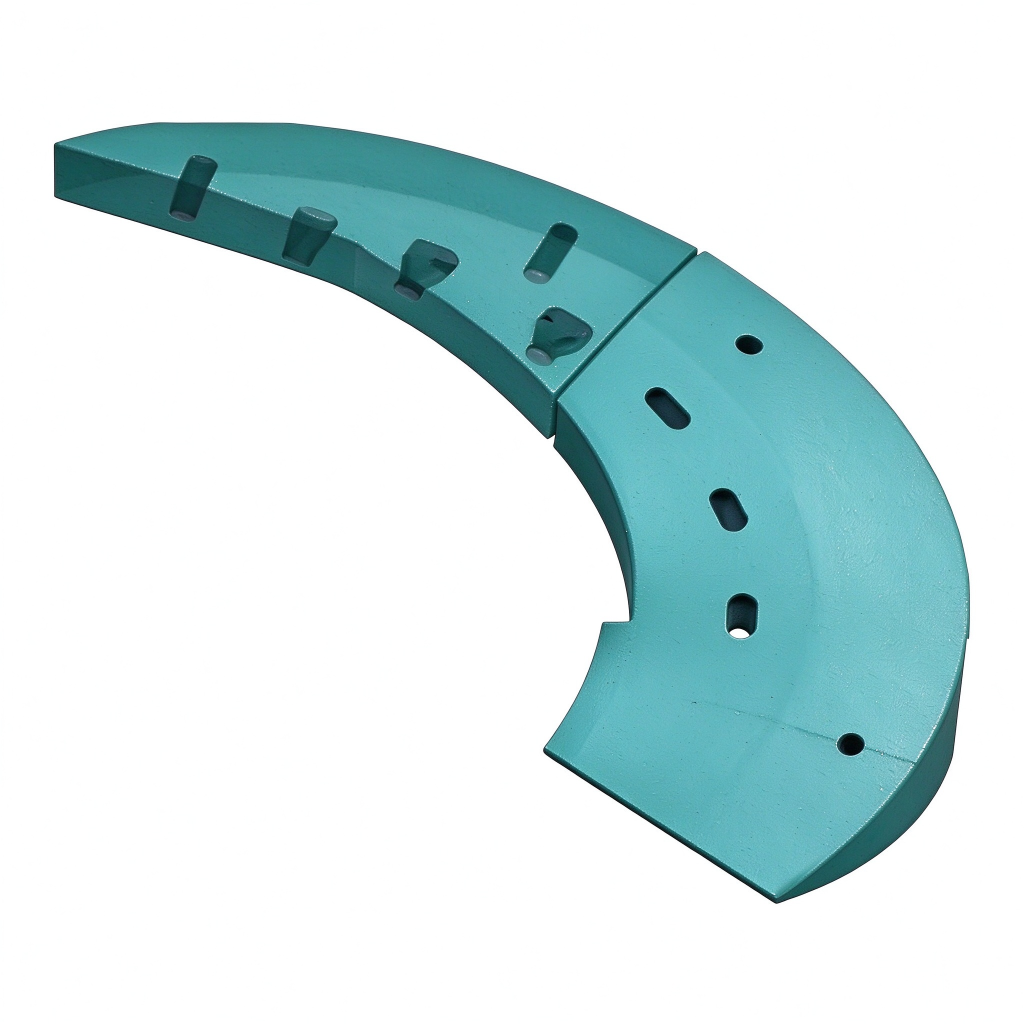
High-Chrome White Iron (HCWI)
An alloy white iron carrying 12–26% chromium and 2.0–3.6% carbon. Its M7C3 eutectic carbides run HV 1300–1800 — harder than the quartz it grinds — and they carry the wear instead of the matrix.
Alloying and heat treatment break the carbide network into a discontinuous one, which protects the matrix from fragmentation. The result: high strength, real toughness and outstanding wear resistance in one casting. Widely used in mining, cement and power grinding.
- Grades suppliedCr20 · Cr20-M · Cr15-HC · Cr15-LC
- Carbide hardnessM7C3 eutectic, HV 1300–1800
- Hardness range520–650 HB
- MicrostructureMartensite + eutectic carbides + retained austenite
- Heat treatmentQuench and temper
- Best applied toLow-speed mills, AG mills, corrosive duties
High-chrome white iron — chemistry and properties
Four high-chrome analyses, from the abrasion-max Cr20 to the tougher low-carbon Cr15-LC. Where each grade earns its place:
- Middle and low-speed mills — with no direct ball striking, HCWI plays its maximum value against pure abrasion and grinding.
- Top ball size 60 mm and under, or ball-less charges such as AG mills — light impacts make abrasion the dominant wear mechanism, and high-Cr iron matches better than any steel grade here.
- Strong acid and alkaline slurries — high chromium and molybdenum alloying gives the matrix strong corrosion resistance.
| Grade | Chemical elements (%) | |||||||
|---|---|---|---|---|---|---|---|---|
| C | Si | Mn | Cr | Mo | Cu | P/S | Ni | |
| Cr20 | 2.5–3.2 | 0.4–0.8 | 0.8–1.2 | 18–23 | 0.3–0.6 | 0.3–0.5 | ≤0.06 | – |
| Cr20-M | 2.5–3.2 | 0.4–0.8 | 0.8–1.2 | 18–23 | 1.2–1.8 | 0.8–1.2 | ≤0.06 | – |
| Cr15-HC | 2.3–3.2 | 0.4–0.8 | ≤1.5 | 14–16 | 0–3.0 | ≤1.2 | ≤0.06 | 0–1 |
| Cr15-LC | 0.9–1.5 | 0.4–0.8 | 0.6–1.2 | 14–16 | 0.8–1.2 | 0.3–0.5 | ≤0.06 | – |
| Grade | Hardness (HB) | Impact Ak (J/cm²) | Microstructure |
|---|---|---|---|
| Cr20 | 580–650 | 3–4.5 | M + C + A |
| Cr20-M | 600–650 | 3.5–6 | M + C + A |
| Cr15-HC | 550–600 | 4.5–8 | M + C + A |
| Cr15-LC | 520–580 | 8–15 | M + C + A |
M = martensite, C = carbide, A = austenite. Eutectic M7C3 carbides run HV 1300–1800 — harder than the abrasives they face. Ak = unnotched Charpy impact energy. Cr15-LC is the lower-carbon (0.9–1.5% C) variant: it trades hardness for roughly double the impact toughness of Cr20. Values are guaranteed per heat; mill certificates issued with every shipment.
Which material for which position
This is the table we would draw on a whiteboard during a customer visit. In most mills the answer is a mix — and mixing is the point, because one grade cannot be right in every position.
| Position | Dominant mechanism | First choice | Why |
|---|---|---|---|
| Shell — coarse chamber | Impact + abrasion | Manganese | Work-hardening resists impact without cracking |
| Shell — fine chamber | Abrasion | Cr-Mo | Higher as-cast hardness lasts longer where impact is low |
| Low-speed mills & AG mills | Sliding abrasion | High-Cr | Eutectic carbides give maximum hardness where impact never work-hardens steel |
| Head liner — feed end | Heavy impact | Manganese | Toughness governs; hard grades spall here |
| Head liner — discharge | Impact + slurry erosion | Mn18Cr2 | Compromise grade for mixed duty |
| Grate plates | Erosion / slot wear | Cr-Mo | Holds slot geometry longer |
| Lifter bars | Impact, profile critical | Manganese | Resists breakage at the leading edge |
| Pulp lifters | Sliding abrasion | Cr-Mo | Erosion resistance dominates |
Why the furnace matters as much as the chemistry
A correct chemistry poured into a casting and cooled the wrong way becomes the wrong material. Heat treatment is where most liner quality is won or lost.
| Grade family | Treatment | Why it is done | What we record |
|---|---|---|---|
| Manganese (Mn13 / Mn18 / Mn18Cr2) | Water toughening | Solution treatment to retain austenite; without it the casting is brittle | Furnace curve, quench record |
| Cr-Mo alloy steel | Quench and temper | Develops hardness and tempers to the specified toughness | Austenitising and tempering temperatures, hardness results |
What we measure, and what you receive
Spectrometer
Optical emission analysis of every heat before pouring — not after.
Hardness
Brinell testing on the casting, reported per batch.
Microstructure
Microscopic examination for manganese grades and on request for Cr-Mo.
Documentation
Chemistry, hardness and dimensional reports supplied with the order.
Not sure which grade your mill needs?
Send the drawing together with what you are running now and how it failed. If the failure is cracking, the material was probably too hard. If it is thin and even wear, it was probably too soft. That single piece of information usually settles the question.
Send us your drawing — get a quote within 24 hours
Upload DWG, PDF or STEP files. Our engineers review every drawing and come back with a technical reply and a firm quotation — no obligation.